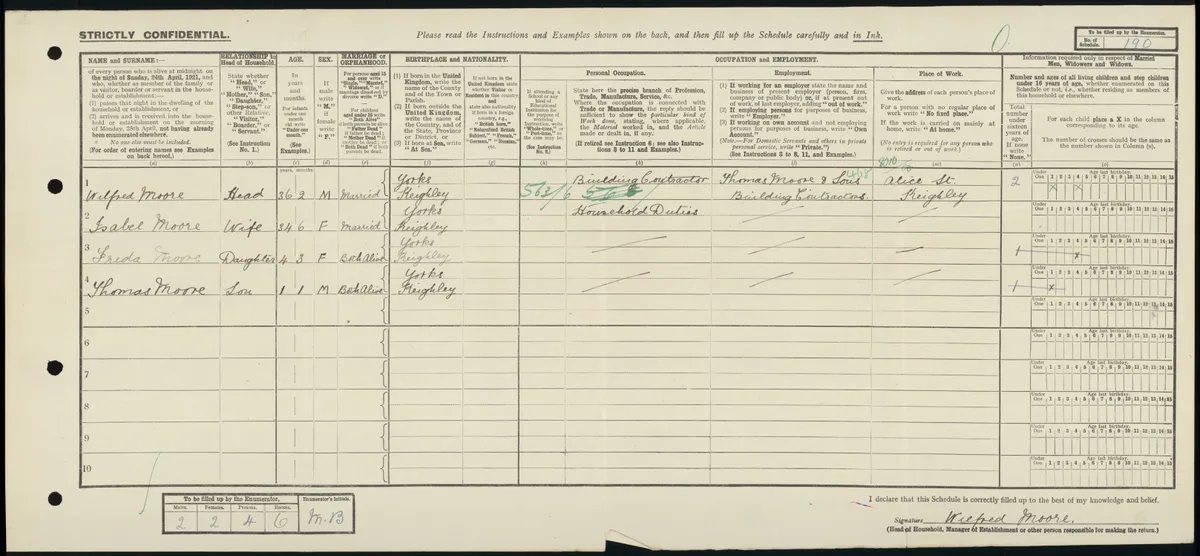
On the night of 18 April 1926, the Irish Free State counted itself for the first time. A century later, on 18 April 2026, the records were released on the website of the National Archives of Ireland (NAI), opening a vivid window onto everyday life in a society finding its feet after revolution and civil war. They are also now available on Ancestry and Findmypast.
The first national enumeration of the Free State was designed to provide an authoritative picture of population, households, work, language and religion in the new political order, which would offer the state the essential baseline that it needed for social and economic planning in the wake of independence.
There had been no Irish census in 1921, unlike in England, Scotland and Wales, because of the War of Independence. This meant that policy makers, local authorities and businesses entered the mid-1920s without an up-to-date statistical map of the country they were trying to build. The 1926 count was therefore both practical and symbolic: a methodical taking of stock at a decisive moment in national life.
It is important to note that a census was held both sides of the border, but individual Household Returns for the 1926 census of Northern Ireland have not survived. However, a full suite of statistical volumes, covering population, age structure, industries, religion, housing and other topics is available online through the Northern Ireland Statistics and Research Agency (NISRA). These reports provide essential context for anyone researching families who moved between north and south in the years following partition.
What was asked in the 1926 Irish census?
The power of the 1926 Irish census lies in the granularity of the questions it asked, and in the way two complementary forms together describe both people and places.
A notable change this year was the introduction of bilingual household forms. For the first time, families could complete the Household Return (Form A) in either English or Irish, offering researchers a rare, ground-level view of language use in homes and local communities. This choice adds an additional cultural layer to the data, revealing not only who lived together, but how households chose to express themselves within the new state.
One of the most striking procedural shifts in 1926 was the removal of specialised institutional forms. In earlier censuses, ships, barracks, prisons, hospitals, workhouses and boarding schools were enumerated using bespoke returns designed specifically for those environments. In 1926, by contrast, everyone – whether in a private home or an institution – appears on the same Form A.
This integration has significant research advantages. Individuals temporarily in hospital, serving in the army, studying at a boarding school or residing in an industrial school are now easier to locate within a single, unified system of Household Returns. Their presence is more clearly embedded within the broader population, offering a fuller picture of how institutions and families intersected in the early Free State.
Another structural change marks a departure from the Edwardian forms that were used in 1901 and 1911. Whereas earlier returns accommodated up to 15 individuals, the 1926 version of Form A provides space for only 10 people per sheet. Larger households therefore spill across multiple forms, subtly reshaping how family and institutional groupings appear in the archival record.
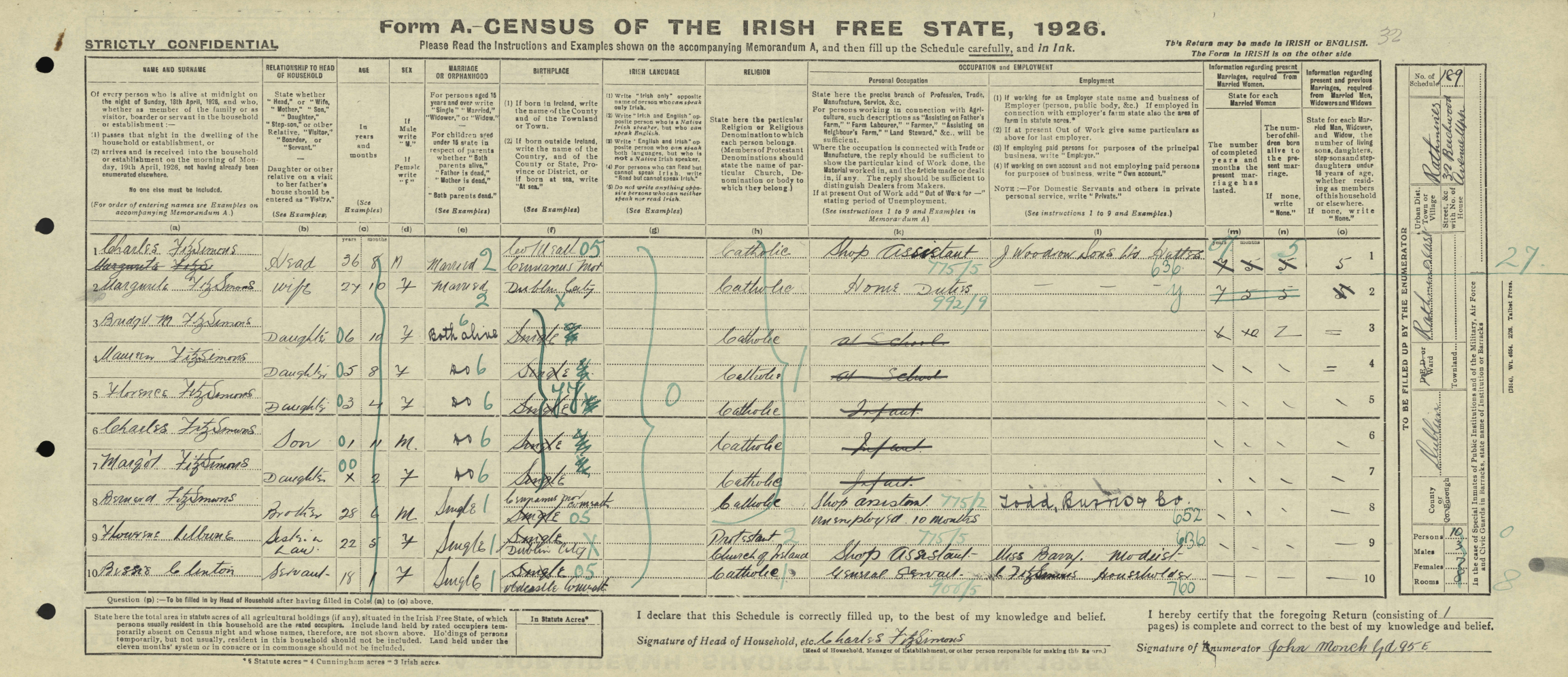
Form A listed every person present in a household or institution on census night and gathered 13 data fields: name; relationship to the head of household; sex; age; marital status or orphanhood; birthplace; Irish language ability; religion and occupation (two fields: personal occupation and employer/business); marriage details for married women; and information on living children/stepchildren under 16 for men, widowers and widows, as well as acreage of occupied agricultural land.
The Enumerators’ Return (Form B) recorded address information, a description of houses, and statistical information on each household.
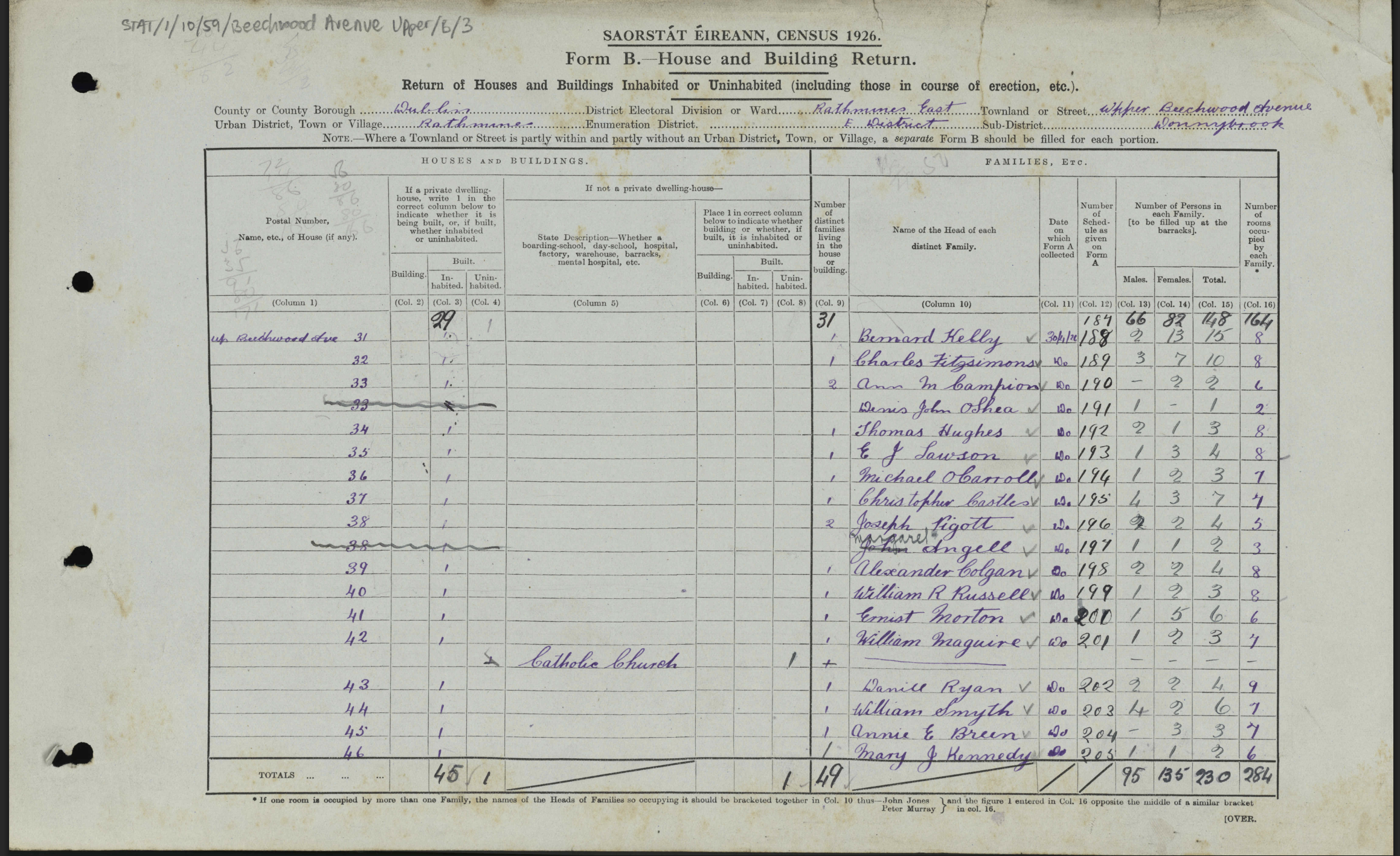
Together, Forms A and B enable researchers to reconstruct households, map different communities, and trace the fabric of daily life, now enriched by the added perspective of bilingualism, and the details of larger families or shared dwellings are captured across multiple sheets.
How the 1926 Irish census was preserved
The survival and structure of the records are a story in themselves. The 1926 returns have been preserved in a meticulously ordered arrangement that mirrors the original enumeration areas across all 26 counties.
Physically, they are held in canvas-bound volumes/portfolios grouped by District Electoral Division (DED) and townland/street, the same administrative geography that underpins the browse-by-location facility on the new census website.
For the centenary release, the NAI undertook a multi-year programme of cataloguing, conservation, digitisation and transcription so that every sheet can be searched and seen at high resolution. The conservation team assessed every single form, repairing fragile paper, removing degraded metal fasteners, cleaning, and flattening creases to prepare for scanning. The digitisation stage captured hundreds of thousands of pages in full colour at 400 dpi resolution, with images preserved in archival formats and converted for public access, while millions of data points were transcribed to build a structured database, refined by manual checking and training informed by known patterns
from the 1911 data.
What can we learn from the 1926 Irish census?
The 1926 census returns reward genealogists, social historians, policy researchers and curious families alike, because it speaks at both the macro and micro levels, from national trends to the names inside a single house.
At a population level, the data provides a snapshot of a country still experiencing long-term decline rooted in the later 19th century, even as Dublin shows early signs of urban expansion. It reveals how the economy was overwhelmingly agrarian, with clusters of manufacturing, domestic service, and fishing shaping local labour markets; it charts religious affiliation and language ability at a time when identity and culture were key political questions; and it records household forms, including widowed heads of household, extended families, and children living elsewhere that illuminate the social consequences of a turbulent decade.
At a household level, the two-form design enables you to trace marriages, migration (through birthplaces and the presence or absence of family members) and landholding, often down to the area of a family’s agricultural holdings. For many of us, it will be the first time that a grandparent or great grandparent appears in a census, anchoring family stories that were told around kitchen tables to a particular address, occupation and moment in time.
How the 1926 Irish census was released
In 2022, the Irish government confirmed funding and a programme to digitise and publish the 1926 returns online, recognising the value of opening this material to a global audience with Irish roots and interests. The returns include every individual counted in the Free State in 1926 and can be searched and browsed for free, following the precedent set by the 1901 and 1911 projects.
Legally, the publication reflects Ireland’s ‘100-year rule’ for census personal data: information that relates directly or indirectly to an identifiable person may be released 100 years after the census date. In practice, this means that the 1926 census became public in April 2026, with the returns formally transferred to the NAI for public inspection in line with the 1986 National Archives Act.
The archive’s guidance also explains an important practical safeguard: if a living person’s data appears in the 1926 returns because they were born before 18 April 1926, an opt out/redaction is available on request, which will remove the lines that pertain to that individual while leaving the remainder of the household record intact.
Taking 1926 on its own tells us a great deal; placing it in the longer story of Irish censuses makes it even more revealing. The 1901 and 1911 returns, now foundational to family history research, book-end a 20th-century turning point; 1926 then captures the aftershocks and the early shaping of the Free State’s social profile. In a single, comprehensive sweep, the census offers a statistical portrait that is also, in thousands of individual hands, a collection of personal signatures.
When the material went live on 18 April 2026, the interface was built on the familiar pathways developed for the online release of the 1901 and 1911 censuses. You can search by name or place, or browse county, district electoral division, townland/street, and then click through to a household page that brings together the transcription and the digitised image of the form.
The release is accompanied by a major public programme that animates the human stories behind the census forms, which includes exhibitions in Dublin Castle, the British Academy in London, and Boston College, Massachusetts, USA, in addition to one that will tour Ireland.