
The world is full of incredible innovations: the wheel, electricity and the internet to name but a few. Once groundbreaking creations, they are now just part of our daily lives, barely registering as things that were once exciting and novel. But there’s one invention that’s arguably been central to human civilisation that’s often overlooked. And yet, as we go about our daily business, literally, the humble toilet is perhaps the innovation least likely to garner any appreciation. We should all take a minute to reflect on the masterminds that made it what it is today.
Ask the average person who they think invented the loo and they’ll probably say it was the brainchild of Thomas Crapper. If this were correct, it would perhaps be one of the funniest examples of nominative determinism in history, but it’s sadly not the case. The origins of the toilet are, in fact, as labyrinthine as London’s sewer network – and far older.
According to the British Association of Urological Surgeons (BAUS), some of the earliest toilet systems date back to 3000 BC when settlers built stone huts equipped with drains at Skara Brae on the Scottish archipelago of Orkney. Other examples have been found during excavations in the Indus Valley (part of modern-day Pakistan and northern India), which unearthed small sewer networks that used flowing water to carry waste into pits, post-dating the Neolithic Scots by about 1,000 years.
Getting a handle on it
By 1700 BC, the Greeks had considerably upgraded lavatories – particularly for royalty – and the Palace of Knossos featured a flushing water supply connected to large earthenware pans. Communal conveniences, meanwhile, had become a widespread feature of daily life. By 315 AD, the Romans boasted 144 public loos comprising rows of benches on which they not only shared news, but a sponge fixed to a wooden handle instead of toilet paper. Wonder no longer where the phrase “getting hold of the wrong end of the stick” comes from.
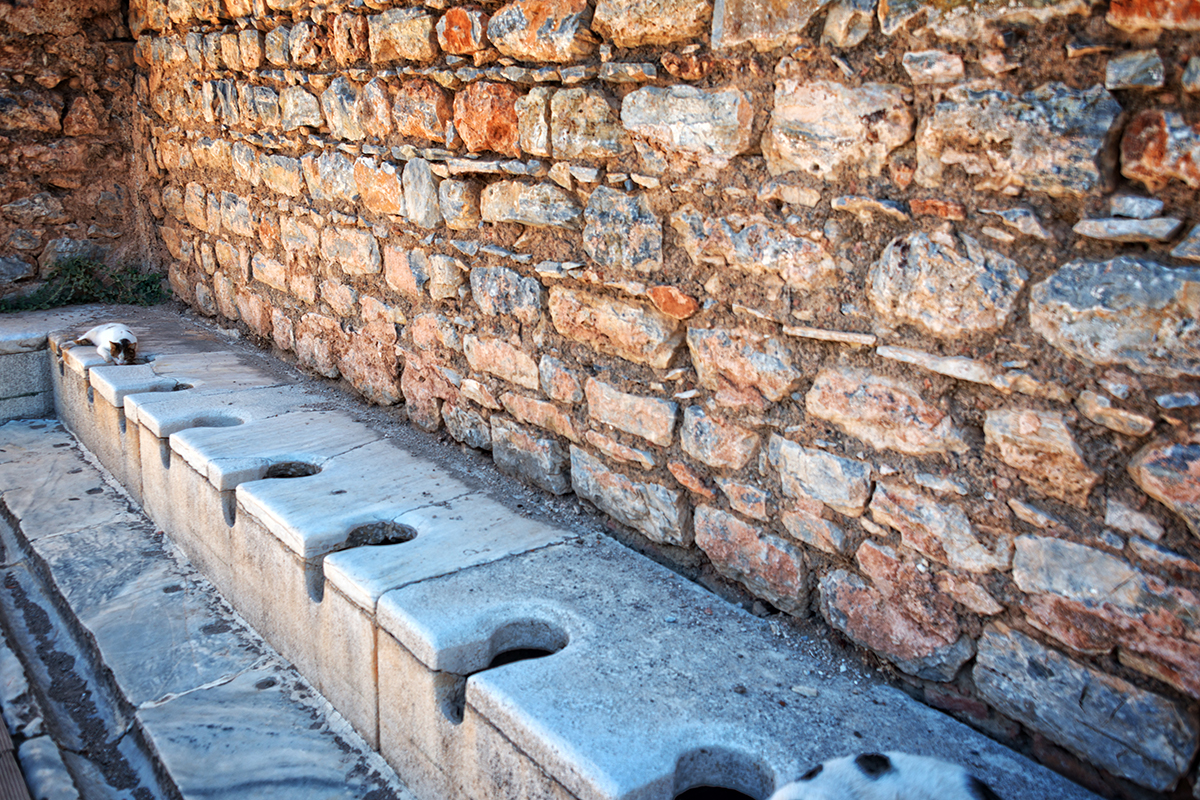
Despite early leaps in the development of ‘houses of easement’, seemingly little had changed by the middle ages; a 128-seat longhouse founded in 1421 by London mayor Richard Whittington (he of pantomime fame) was similar to the Roman blueprint. On the plus side, it was believed to be the first public toilet in London to segregate by sex; on the downside, the waste ended up in the River Thames – the result of which quite literally plagued people for years.
In the home, things were not much better. According to BAUS, the working classes of medieval England dealt with domestic waste by chucking the contents of ‘potties’ out of the door or window and into the street. In France, the same method of disposal was used, with the added cry of “gardez-l’eau” – which roughly translates as “watch out for water”. This is thought to be the origin of the English term ‘loo’.
Business as usual
The upper classes were more modest about where they did their business. Many used ‘garderobes’ – a room suspended over a moat with an opening for waste – or lidded commodes optimistically adorned with velvet, lace and sprigs of herbs to mask odours. The latter was a set-up favoured by Elizabeth I until her godson, Sir John Harrington, invented what we would recognise as the first modern convenience.
Sir John’s 1592 design for a water closet included a raised cistern and downpipe through which to flush waste. Dubbed ‘Ajax’, he proudly showed it to his godmother, who was said to be so impressed she ordered one for a royal residence. However, it didn’t catch on with the chamber pot-faithful public and Sir John was never formally credited with inventing the flushing toilet.
That distinction went to Alexander Cumming almost two centuries later. His design in 1775 centred around the creation of the S-shaped trap, or U-bend, which allowed the contents of the closet to be emptied every time it was used. Other patents swiftly followed: a plunger-operated WC in 1777 by Lemuel Prosser; a pressurised handle-operated version the following year by Joseph Bramah; and a “self-acting” WC featuring a system of pulleys designed by Thomas Ginn in 1840.
At your convenience
The flushing toilet went from strength to strength. In 1851, the Great Exhibition in Crystal Palace included the installation of Josiah George Jennings’ modern flush toilets, created for use in railway stations and public spaces. Some 800,000 curious punters spent a penny (thus coining the phrase) to test them out. His design, which featured a pan and trap formed in one piece and is recognisable as the basis for toilet designs today, was so popular that the following year “public waiting rooms” were mainstream, though the vast majority were for men.
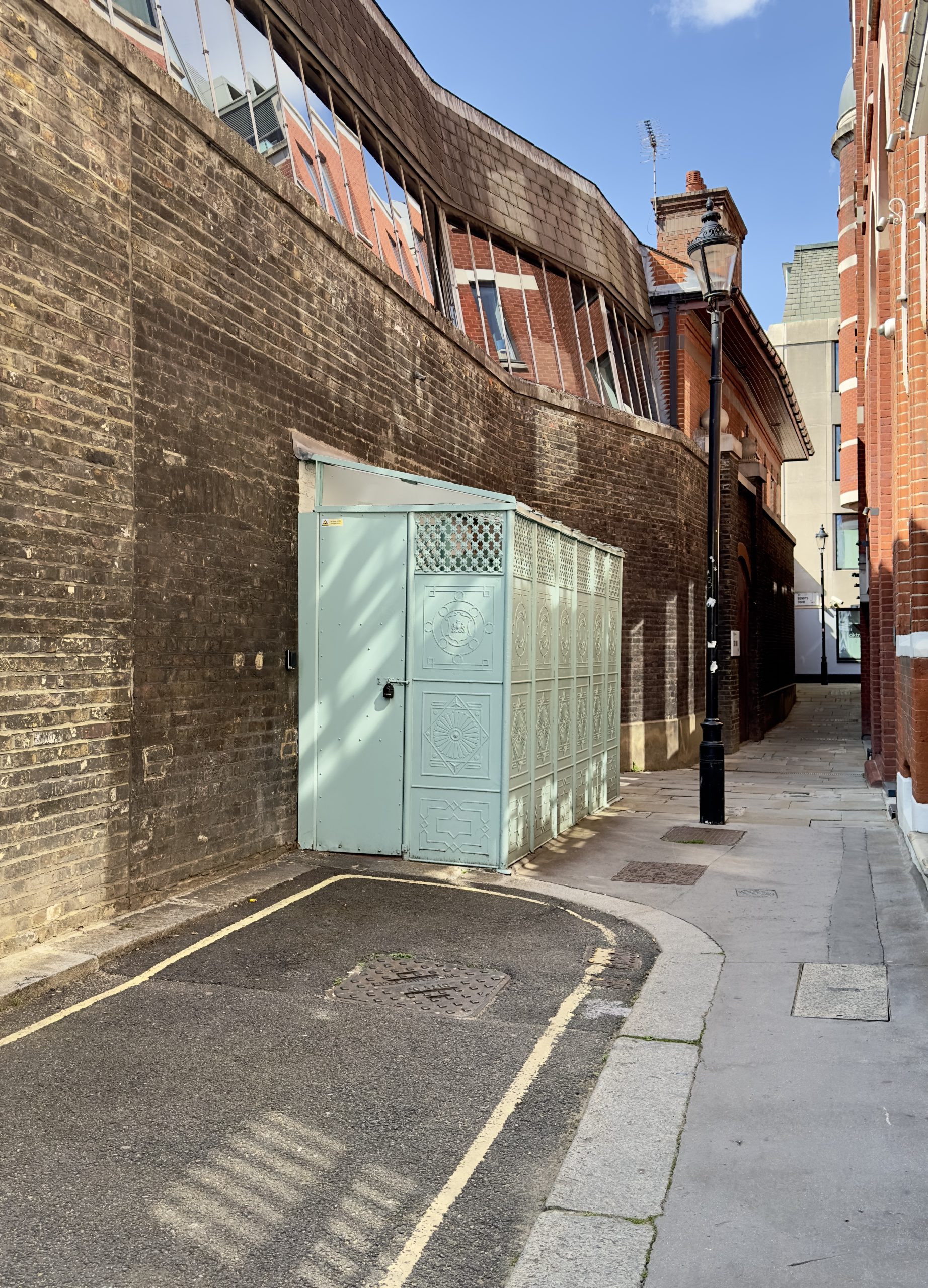
Indoor flush toilets had also become commonplace in middle-class homes, but modern sanitation had not caught up with burgeoning toilet tech. In the absence of sewers, the waste from both private and public facilities flowed directly into the UK’s waterways and streets, causing cholera outbreaks that killed tens of thousands.
The government had to act. In 1848, it passed legislation that every new dwelling had to have a privy or ash pit, the contents of which were collected by “night soil men”. According to Findmypast, the job paid 23 shillings a week. This unsavoury work was undertaken by hundreds of able, if not entirely willing, workers. But waste from these primitive facilities – which were often shared by multiple families if not a whole street – still seeped into the ground and water supplies, worsening the spread of waterborne diseases.
It wasn’t until a decade later that real change began to take place. The hot summer of 1858 caused a stench from fermented waste in the Thames so egregious that ministers were compelled to accept Joseph Bazalgette's proposal of a modern sewer network. It took years to complete – from 1859 to 1875 – but the ‘Big Stink’, as it was known, ushered in the creation of a vast network of tunnels that diverted the capital’s waste from the river and ended repeated cholera outbreaks.
Sanitary conditions
By the end of the 19th century, the sanitation industry had truly flourished and was even evident on the UK census. John Smeaton, who held patents for WCs in 1887, declared his occupation in the 1891 census as a “sanitary specialist”, alongside his son, a “training sanitary specialist”. Though his company was listed as bankrupt in the London Gazette the following year, he was one of several in the trade who made their mark in designing decorative, ceramic water closets synonymous with the ornate style of the Victorian era.
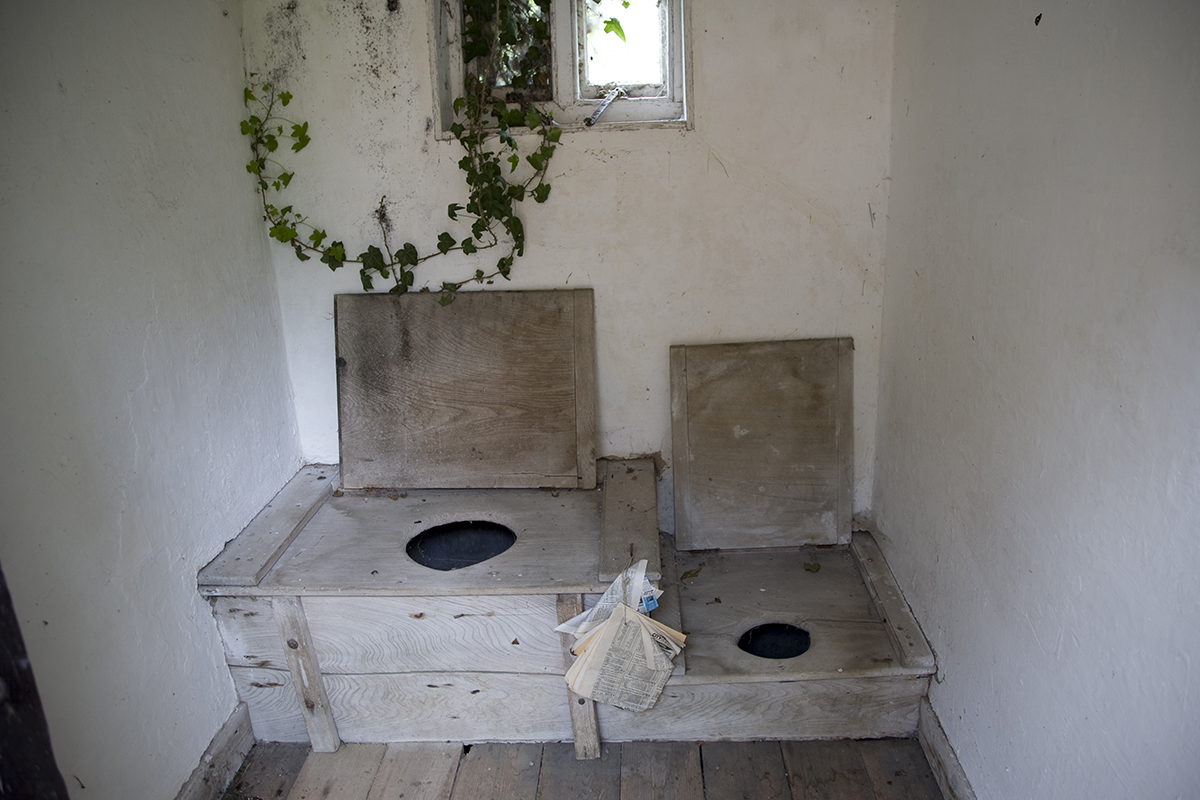
His contemporary Thomas William Twyford lodged four patents between 1884 and 1888 for various designs including The Unitas, a freestanding earthenware WC, which claimed to eliminate filth and smells as it was not enclosed by woodwork. His success was such that he exported his WCs worldwide and had showrooms in Australia, South Africa and Germany – a marketing tool pioneered by Thomas Crapper.
Though he cannot, as legend has it, be credited with inventing the porcelain throne, he did have the foresight to open the world’s first toilet showroom in Chelsea in 1870. As the prospect of a toilet in one’s home became more common – at least for the wealthy – Crapper’s business grew and included several royal warrants for palace installations. His success is perhaps best underscored by the fact that the firm remains in business today.
While the well-off could afford an indoor loo, it was rare in working-class homes. Terraced houses, in particular, had outside toilets much later than you might imagine. In 1967, the House Conditions Survey found that 2.5 million homes in England and Wales still didn’t have an indoor WC, while 25 per cent lacked a bath or shower, a sink and hot and cold running water. The number of homes that fail to meet this standard in the UK today is almost too small to measure. The same cannot be said for the US, however. According to research published in 2021 by the Plumbing Poverty Project, some half a million citizens – typically people of colour and those who rent – lacked running water or flushing toilets.
Caught short
Neither have public toilets ever been widely available in the US, with data suggesting an average of only eight per 100,000 people in 2023. In the UK, where the public toilet was once deemed so crucial that the Ladies’ Sanitary Association campaigned tirelessly for facilities for women, the British Toilet Association estimated that their availability has halved since 2010 and Victoria Plumbing has predicted they will be extinct by 2105.
Those that do remain are often hotspots for drugs and cottaging, or are so dilapidated they await demolition. But a rare few have found new life as bars and coffee shops, marking yet another chapter in the evolution of the lav, which even now, continues to be the subject of innovation. The 20th century saw the introduction of automatic flushes, the sealed ‘vacuum’ design seen on planes, and models that compost waste. In the age of smart tech, newer features include self-cleaning bowls, motion-activated lids and heated seats.
So the next time you flush, spare a thought for the thousands of years of trial and error, and quite a lot of unpleasantness, that have brought us here. The toilet remains one of the most transformative human inventions – not glamorous, but essential – and worthy of a place on a pedestal.
